
Survival Damage Reduction Layers
Understand true damage, resistances, armor, block, Tenacity Blessing, global reduction, and damage over time mitigation as practical survival layers.
This site focuses on system understanding and decision support; for season, build, or budget-sensitive advice, check the page date and current version context.
Why a Tanky Character Still Gets One-Shot
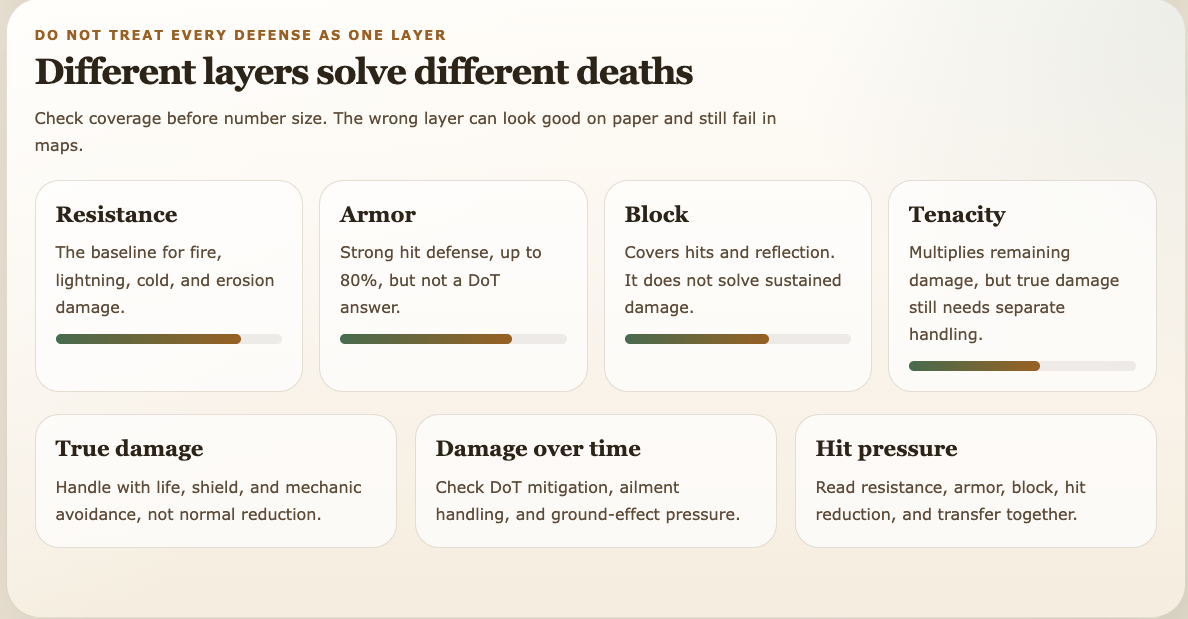
First check what actually killed you. Resistance, armor, block, and Tenacity Blessing all matter, but none of them covers everything. Some layers only work against hits, some do nothing against damage over time, and true damage usually bypasses regular reduction entirely.
When you review survival, do not start with "how much reduction do I have?" Start by separating the death source:
- Is the death caused by true damage? If yes, most reduction layers do not help.
- Is it a hit or damage over time? Armor, block, and damage transfer do not cover every case.
- Which layer is missing: resistance, hit defense, or damage over time control?
- Then decide whether the next stat should push an existing layer higher or fill a missing layer.
The common mistake is treating every defensive stat as one large pool. Most reduction works by multiplying the remaining damage. A high layer becomes very valuable near its cap, but a missing layer can still get bypassed.
Separate True Damage First
True damage is the exception you should identify early.
- True damage directly removes life and is not reduced by regular damage reduction.
- Global reduction from effects like Light-Hunting Belt, Double Rainbow, or Tenacity Blessing does not reduce true damage.
- There is currently no stable regular defense layer that directly reduces true damage.
- True damage removes shield before life.
If the problem is true damage, do not first invest in armor, resistance, or block. The practical answers are usually:
- increase your life or shield pool so you can survive the event
- avoid the trigger or the dangerous positioning pattern
- solve it through encounter handling rather than normal reduction
Why High Reduction Gets More Valuable
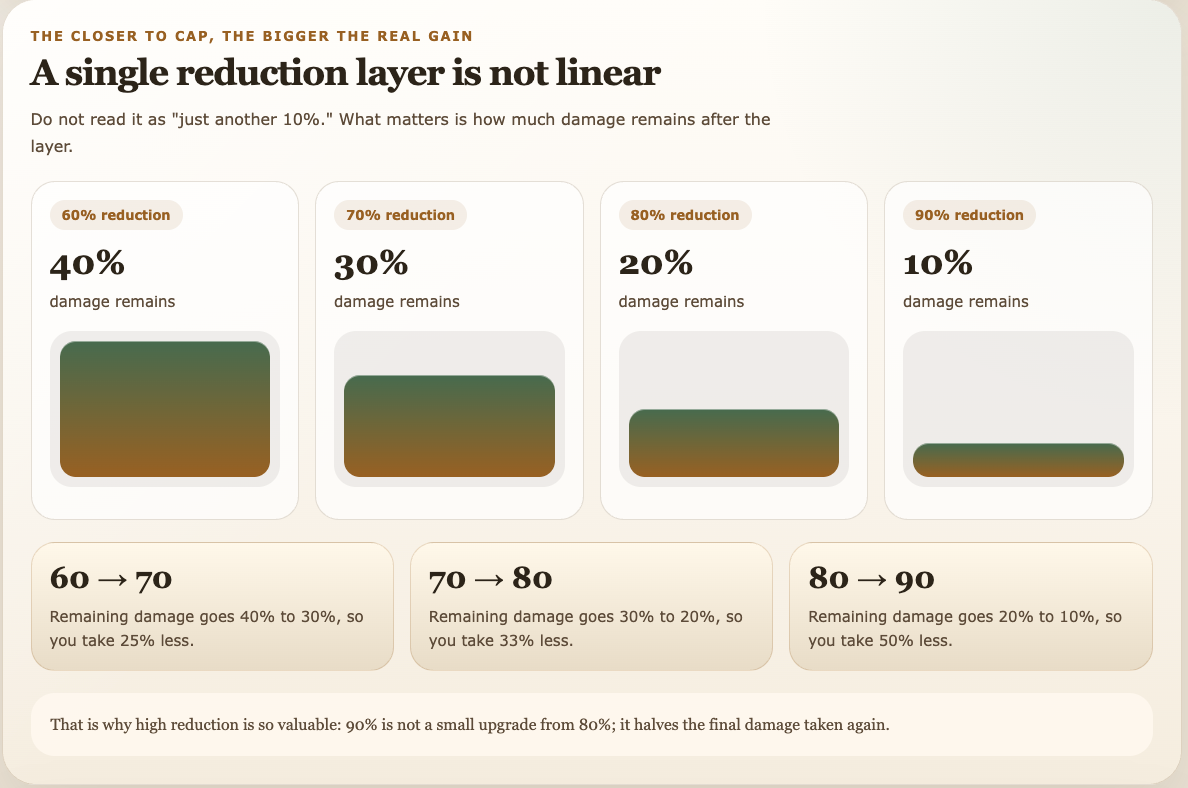
Damage reduction is not linear. What matters is the damage left after reduction.
- At
60%reduction, you still take40%damage. - Moving from
60%to70%changes remaining damage from40%to30%, so you take25%less than before. - Moving from
70%to80%changes remaining damage from30%to20%, so you take33%less than before. - Moving from
80%to90%changes remaining damage from20%to10%, so you take50%less than before.
That is why high reduction layers matter.
90% reduction is not just a little better than 80%; it halves the final damage taken again.
Still, that does not mean every build should stack only one stat. A safer build usually pushes two important layers:
- one broad layer, such as resistance
- one situational layer, such as armor, block, damage transfer, or damage over time mitigation
This gives you the nonlinear gain of high reduction while avoiding obvious holes.
The Multiplication Rule
Most reduction can be read like this:
final damage taken
= original damage
* (1 - reduction A)
* (1 - reduction B)
* (1 - reduction C)
* ...
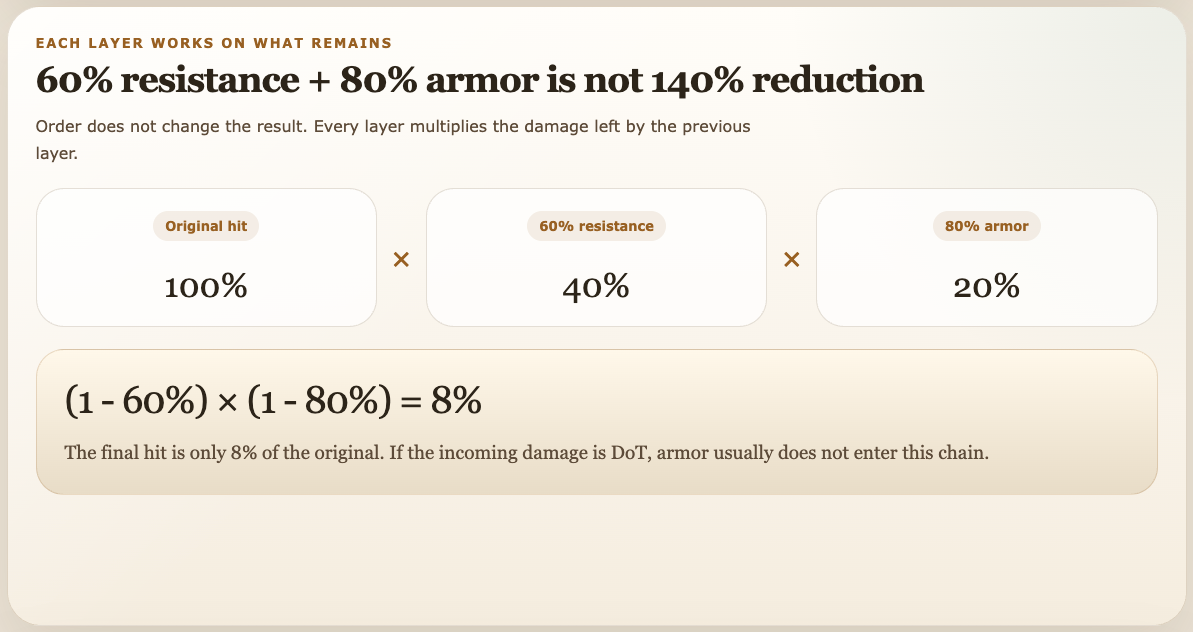
Order does not matter. Resistance first, armor first, or Tenacity Blessing first gives the same final result. Each layer works on the remaining damage.
Example: Resistance plus Armor
Suppose a hit is affected by:
60%matching resistance80%armor reduction
The final damage taken is:
(1 - 60%) * (1 - 80%) = 40% * 20% = 8%
So you take only 8% of the original hit.
Example: Damage Over Time Does Not Use Armor
If the same character has 60% matching resistance but the incoming damage is damage over time, armor does not apply:
(1 - 60%) = 40%
You still take 40%.
This is why a build can feel tanky against hits but still melt in ground effects, ailments, or other sustained damage.
Example: Multiple Damage Over Time Reductions
If you have:
60%matching resistance- two
40%reduced damage over time lines
The final damage over time taken is:
(1 - 60%) * (1 - 40%) * (1 - 40%) = 14.4%
If you have three 40% damage over time reduction lines and 4 stacks of Tenacity Blessing at 4% each:
40% * 60% * 60% * 60% * 96% * 96% * 96% * 96% ≈ 7.34%
The important point: even repeated lines do not simply add to 120%. Each one multiplies the remaining damage.
How To Read Each Survival Layer
Resistance: the baseline for elemental and erosion damage
Resistance covers:
- fire damage
- lightning damage
- cold damage
- erosion damage
Each 1% resistance reduces matching damage by 1%.
For example, 60% fire resistance means you take 60% less fire damage.
When checking a build, resistance is usually the first baseline. It has broad coverage, but it does not solve physical hits, true damage, or every damage over time problem by itself.
Resistance maximum can be raised, up to 90%. If a build can reliably raise an important resistance cap, the survival gain can be very large.
Armor: strong against hits, not damage over time
Armor mainly works against:
- hit damage
- indirect damage
- reflected damage
Armor can reach up to 80% reduction.
It is one of the best main survival layers for common hit pressure.
Its hard boundary is simple: armor does not reduce damage over time.
If your deaths come from damage over time, ground effects, or ailments, more armor may not fix the problem.
Block: a hit and reflection defense layer
Block covers:
- hit damage
- reflected damage
When both attack block chance and spell block chance reach 100%, those covered damage types are always blocked.
The default block ratio is 30%. It can usually be pushed to 60% through affixes and Pactspirits, while special cases such as Rosa 1 or Silent Confession can go higher.
Block is strong when combined with other layers. Its limitation is coverage: it is not a damage over time solution.
Tenacity Blessing: remaining-damage multiplication
Tenacity Blessing reduces all damage taken and multiplies the remaining damage.
If each stack gives 4% reduction, five stacks are not handled as one flat 20% line. The chain is:
96% * 96% * 96% * 96% * 96%
This kind of stack-based reduction is useful as a stable extra layer, but calculate it per stack.
Global Reduction: broad, but not true damage protection
Global reduction from items such as Light-Hunting Belt or Double Rainbow also multiplies the remaining damage. It is strong because it combines well with resistance, armor, block, and other layers.
But remember the exception: true damage ignores these reductions.
Hit Reduction: only for hit pressure
Hit reduction from sources such as Rock Pactspirit applies to hit damage.
It matters when mapping or bossing exposes you to large hits, but it should not be used to explain damage over time deaths.
Before valuing this stat, ask one question: are you dying to hits?
If not, the value may be limited.
Damage Transfer: not a damage over time answer
Protective Field, talent-based damage transfer to random minions, and Divinity Slate transfer effects also multiply remaining damage.
But these mechanics cannot transfer damage over time.
They help with part of hit survival, not sustained damage pressure.
Damage Over Time Mitigation: the layer many builds miss
Reduced damage over time affixes are the direct answer to damage over time pressure. Multiple lines also multiply the remaining damage.
If your character handles normal monsters and single hits well but collapses in ground effects, ailments, or sustained damage zones, check this layer before blindly adding more armor.
Practical Build Checklist
Use this order:
- Identify the damage form: true damage, hit, or damage over time.
- Check the baseline: matching resistance and life or shield pool.
- Check hit defense: armor, block, hit reduction, and damage transfer.
- Check damage over time defense: damage over time mitigation, ailments, and ground effects.
- Add broad layers last: Tenacity Blessing and global damage reduction compress the remaining damage further.
If you can only fix one thing first, do not pick the largest number. Pick the layer that actually covers your death source.
Core Takeaways
- True damage needs separate handling; regular reduction usually does not affect it.
- Most reduction multiplies remaining damage, so order does not change the result.
- Resistance, armor, block, Tenacity Blessing, global reduction, hit reduction, damage transfer, and damage over time mitigation all have different coverage.
- Armor and block are strong, but they do not solve damage over time.
- Damage over time deaths require damage over time mitigation and ailment handling.
- A practical build usually pushes two important reduction layers instead of only inflating one defensive number.