
Damage Calculation Basics
Read added damage, skill multipliers, inc, more, gain, skill levels, and diminishing returns as one calculation chain.
This site focuses on system understanding and decision support; for season, build, or budget-sensitive advice, check the page date and current version context.
Start With One Mental Model
When you judge damage, do not start from tooltip size. Start from order:
- Does this stat add base damage, or does it amplify damage you already have?
- Is it inc, more, or gain?
- Does it actually match your skill's tags, damage form, and weapon source?
Most cases of "this upgrade looked good but felt weak" come from adding the right number to the wrong layer.
First: where base damage comes from
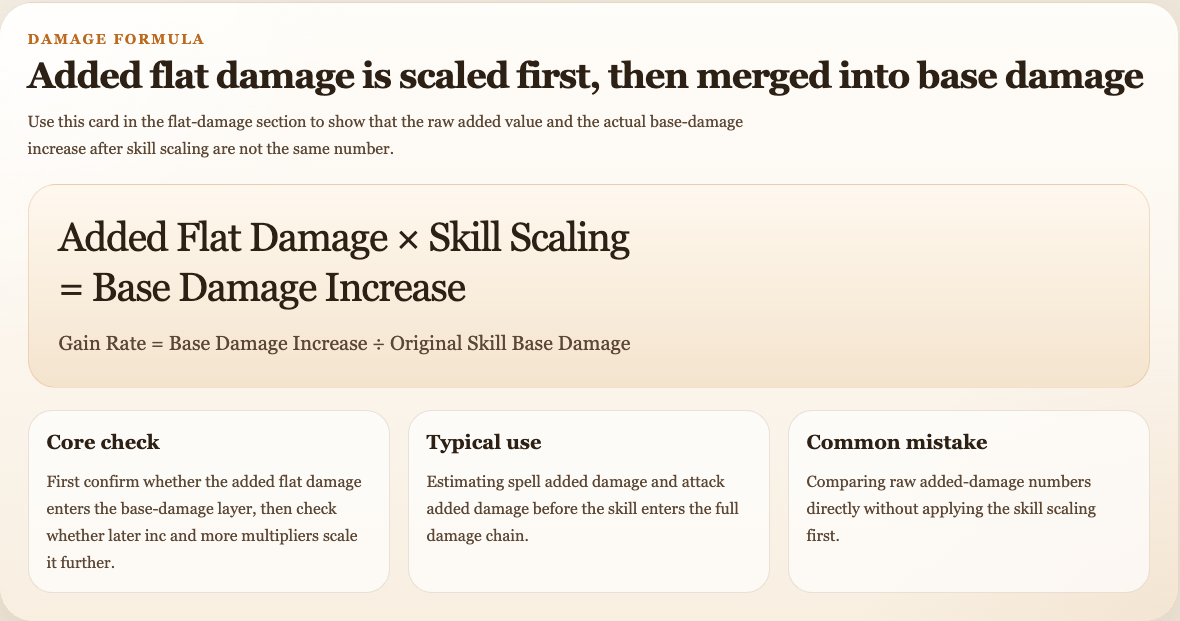
Added damage is scaled by the skill multiplier
For spell skills, the usual formula is:
added damage × skill multiplier = added base damage
Level 20 Shackles of Malice shows:
124%damage multiplier667-667base spell erosion damage
If you link level 20 Added Erosion Damage, that support adds 104 erosion damage. What enters the spell's base bucket is not 104, but:
104 × 124% = 128.96
So the support contributes about 129 base damage. Relative to the original 667, that is roughly:
129 ÷ 667 ≈ 19.3%
This is why flat damage can be better than it looks, as long as you count the skill multiplier.
Spell skills combine flat sources before the multiplier
If you also use Voodoo Wand, which gives 8-8 added spell erosion damage, the flat sources do not multiply each other. They combine first:
(104 + 8) × 124% = 138.88
That is the key rule:
- flat sources share one base bucket
- the skill multiplier scales that bucket
- flat sources do not multiply each other
Attack skills scale weapon damage directly
Attack skills care about how much % weapon attack damage the skill takes from the weapon.
Groundshaker is a clean example:
- first fissure hit:
227% weapon attack damage - second fissure hit:
1135% weapon attack damage
Even before expanding every weapon affix, the skill itself already tells you something important:
1135% ÷ 227% = 5
With the same weapon, the second fissure is five times the first hit at the base layer. That is why high-multiplier attack skills feel so weapon-dependent.
Dual wield has to be read case by case
Do not assume dual wield simply means "both weapons add together."
- many attacks alternate weapons
- base damage and crit can depend on the weapon currently used
- base attack speed depends on the dual-wield rule or the specific skill
Two useful data examples in this repo:
- Burst explicitly says dual wield uses the average of both weapons as base damage
- Joined Force / Ominous Gift style effects add off-hand damage into the main-hand result
So the rule is not universal. Read whether the skill or mechanic says alternate, average, or append off-hand damage into main-hand damage.
Then: how percentage scaling multiplies
Use this chain first
For most hit damage, this version is enough:
final damage
= base damage
× (1 + all inc)
× (1 + more bucket A)
× (1 + more bucket B)
× ...
× (1 + all gain)
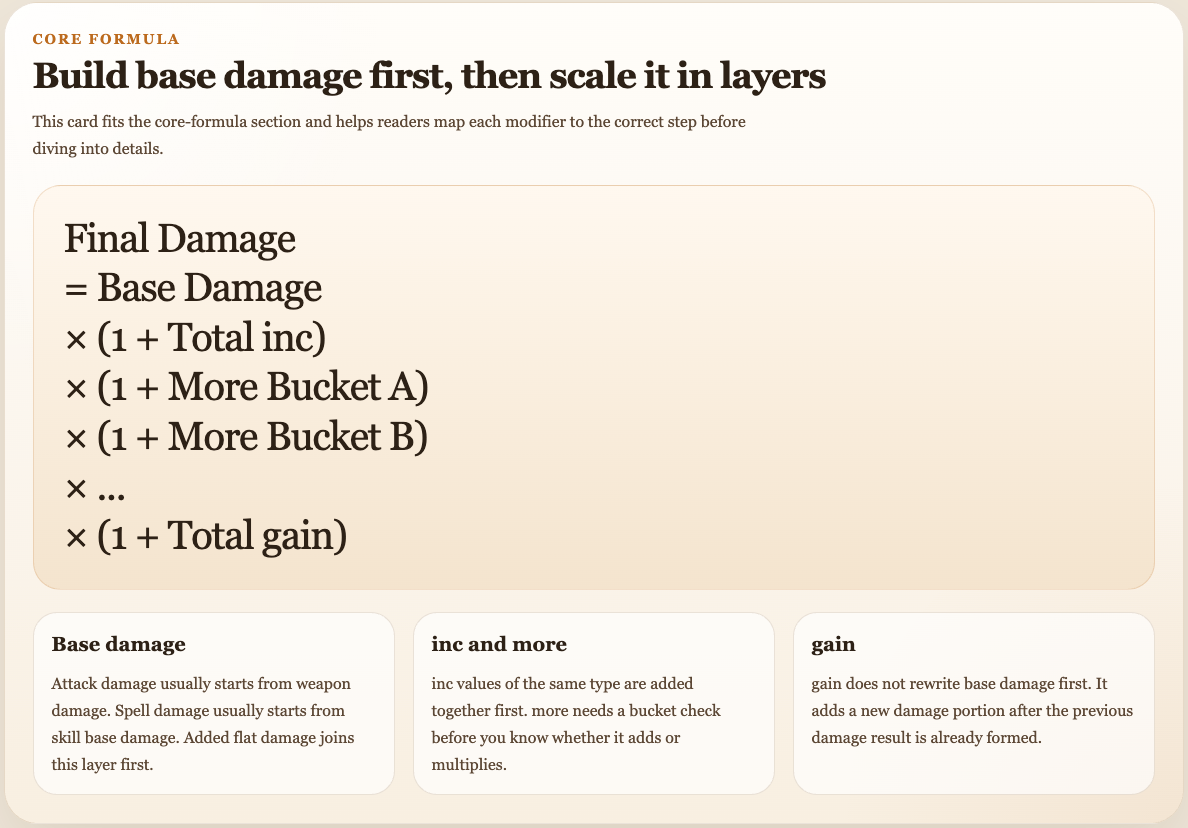
The three parts people mix up most often are:
inc: additive percentage damage in one large poolmore: extra damage that multiplies across different bucketsgain: extra damage added after the earlier layers are resolved
Tags decide whether a stat works at all
A damage stat only helps if it matches the skill.
Shackles of Malice is tagged spell / erosion / chain / area. Meanwhile weapon affix pools can include melee damage.
That means melee damage does nothing for this spell. Matching tags and damage types matter before number size does.
inc stacks in one pool
Typical % physical, % elemental, % spell, % erosion, and many generic % damage sources belong here.
If you already have a lot of the same pool, the next line still helps, but not as much as the raw number suggests.
more: same bucket first, different buckets later
The important question is not only "is it more," but also "is it a new bucket?"
Willpower is a useful same-bucket example:
- each stack gives
+6% extra damage - up to 6 stacks
A practical way to read it is one stacked layer of roughly:
1 + 6% × 6 = 1.36
or about 36% extra damage from that one source.
Now compare that with a different-bucket source. If you also have Double Rainbow giving +17% extra damage from one matched resistance pair, the rough chain becomes:
base damage × 1.36 × 1.17
not just 1 + 36% + 17%.
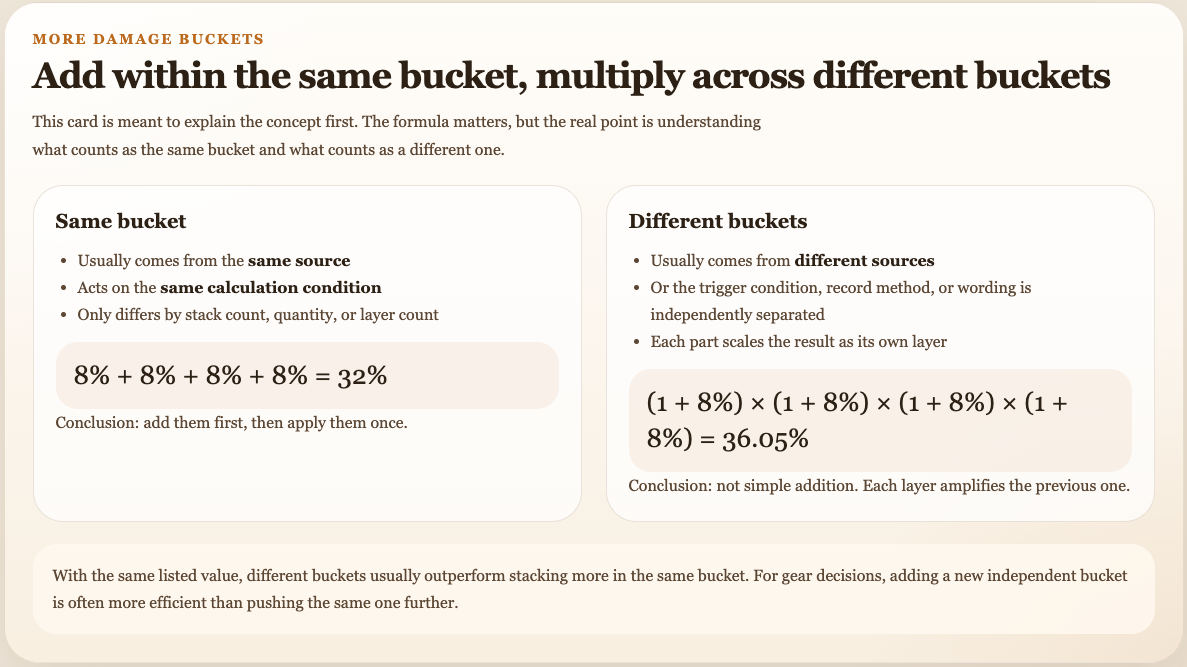
That is why filling a missing multiplier bucket often feels better than pushing an old one further.
gain adds another damage segment after the earlier layers
gain is not the same as flat damage and not the same as basic conversion logic.
Scarlet Decree gives:
- gain
8-10%of physical damage as fire - gain
8-10%of physical damage as lightning - gain
8-10%of physical damage as cold
If your physical hit is already resolved to 10000 before gain, then at the high roll it can add:
1000fire1000lightning1000cold
That is 3000 extra elemental damage after the earlier chain. It does not work like adding 100 flat damage into the base bucket.
Special rules that are easy to misread
Skill level becomes especially valuable after level 20
Skill_Level gives the important breakpoint rule:
1-20: base damage and effect values scale normally21-30: each level adds+10% extra damage (more)31+: each level adds+8% extra damage (more)
That is why level 21 and level 31 matter so much. After 20, you are often buying a multiplier layer, not just more base damage.
Flat damage is amplified well, but it still has diminishing returns
Flat damage is strong because it enters the base bucket, then all your inc and more layers scale it.
But as you add more of it, later additions keep sharing that same bucket. The relative return gradually drops compared with opening a fresh multiplier layer.
Explicit "more" style lines deserve special attention
Good examples from this repo:
- Skill Level:
+10%per level from 21-30, then+8%from 31 onward - Double Rainbow:
+17%-19% extra damage - Ground Divide: supported skill gets
1.5% extra damage - Ailment Termination:
6.7% extra damageper ailment on the enemy
These lines are valuable because they often add a better multiplication layer than another ordinary additive stat.
Stacking one pool has diminishing relative value
Diminishing returns here does not mean the line stops working. It means each next line is smaller relative to what you already have.
With Willpower:
- stack 1: from
1to1.06, a real6%gain - stack 2: from
1.06to1.12, the next stack is only about5.66%relative gain over the previous state
The more you keep pouring into one bucket, the more this effect shows up.
A simple judgement order
When you see a new damage line, run through this:
- Is it base damage, inc, more, or gain?
- Does it match the skill tags?
- Is it working on attacks, spells, dual wield, ailments, or another special rule?
- Is it opening a new bucket or adding more to an old one?
- If it is flat damage or skill level, how many of your current scaling layers will also amplify it?
The stable rule is still the same:
Balanced scaling across multiple buckets usually beats overstacking one number.
Core principles
| Principle | What it means |
|---|---|
| Spread scaling layers | Avoid overstacking one bucket; fill missing base, inc, more, or gain layers |
| Watch marginal return | Same-bucket stacking still works, but each new line is smaller in relative gain |
| Match the actual skill | Tags, weapon source, spell/attack type, and special rules decide whether it works |
Example entries used on this page
- Shackles of Malice
- Added Erosion Damage
- Voodoo Wand
- Groundshaker
- Burst
- Ominous Gift
- Scarlet Decree
- Double Rainbow
- Willpower
- Ailment Termination