
Critical Strike Damage System
Read base crit value, hidden crit value, crit damage, and average return as one crit system.
This site focuses on system understanding and decision support; for season, build, or budget-sensitive advice, check the page date and current version context.
Start With One Crit Chain
Crit is easier to read as one chain:
- Find where the skill gets its base crit value.
- Add all flat and percentage crit value scaling.
- Convert final crit value into crit chance.
- Then check whether your crit damage is high enough for that chance to matter.
A lot of build mistakes come from stacking only one side:
- crit chance side: how often you crit
- crit damage side: how hard that crit actually hits
Base Crit Value
Attacks and spells do not start from the same place
- Attack skills usually take base crit value from the weapon.
- Spell skills usually take base crit value from the skill itself.
- Dual wield, minion, and special mechanics still need to be read case by case.
Practical conversion
Use the simplest conversion first:
100 crit value = 1% crit chancecrit chance = final crit value ÷ 100
Example: Rusted Dagger
- Rusted Dagger base crit value:
500
Before any extra scaling, that means:
500 ÷ 100 = 5%
The point of this example is simple: weapon crit value is not the final answer. It is the starting layer that later crit scaling works on.
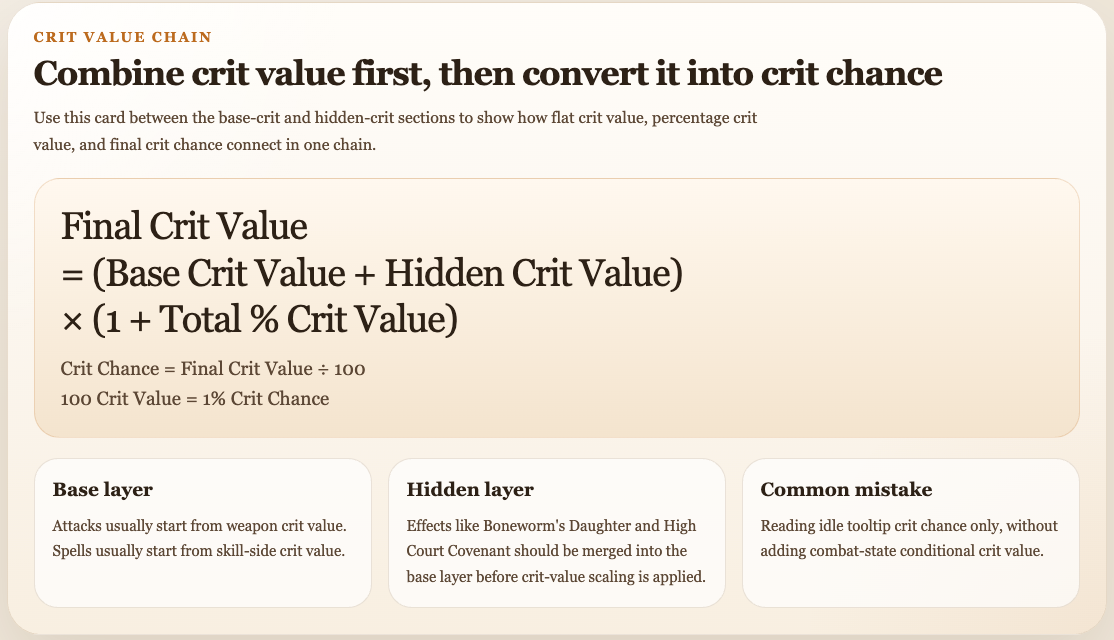
How Final Crit Value Is Built
Core formula
final crit value
= total base crit value
× (1 + all percentage crit scaling)
Read it this way:
- total base crit value: weapon, skill, flat crit lines, and other fixed crit sources
- percentage crit scaling: ordinary
% crit value
Safer public-facing wording for now
The current public entries that are easy to verify in pages-json consistently show:
- flat crit value, such as
+300 crit value - percentage crit value, such as
+60% crit value
What they do not consistently expose is a stable, separate "extra crit value multiplier bucket" comparable to a damage more bucket.
So this page does not model crit value as multiple public-facing multiplier buckets. The safer wording for now is:
- combine all base crit value first
- then scale it with all
% crit value
Example: High Court Covenant
High Court Covenant grants:
+300 crit value+75% crit damage
If an attack build already starts from a 500 base weapon crit value, then that +300 crit value is not a minor side bonus. It first lifts the crit base from:
500 → 800
and only then gets amplified by later crit scaling.
Hidden Crit Value
This is where people undercount their crit most often.
How to read it
A hidden crit source is still a flat crit value source:
- add it into base crit value first
- let it scale with your current
% crit value - convert the result into crit chance
Example: Boneworm's Daughter
Boneworm's Daughter can grant:
+50 spell crit valueper ailment on the enemy- up to
+100
If you currently have:
- 2 ailments, so the full
+100 spell crit value +450%spell crit value
then that hidden crit source becomes:
100 × (1 + 450%) = 550
which means:
550 ÷ 100 = 5.5%
So the line does not stay a flat 100 once it enters your full crit setup.
Crit Damage
Default base
Every unit starts with:
150%crit damage
So a crit does not just happen more often. It also replaces a normal hit with a larger damage multiplier.
Crit damage has to be read with crit chance
The most practical average-gain formula is:
average gain = crit chance × (crit damage - 1)
For example:
55%crit chance with420%crit damage gives about176%average extra damage75%crit chance with500%crit damage gives about300%average extra damage
That is why crit chance and crit damage should be evaluated together, not in isolation.
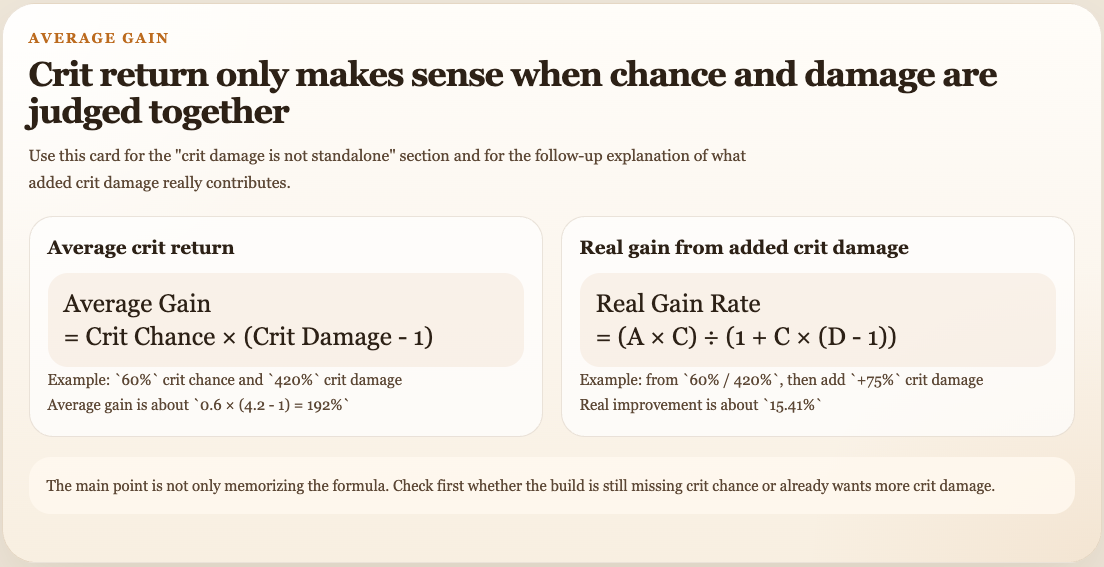
How To Judge Added Crit Damage
If:
Dis your current total crit damageCis your current crit chanceAis the added crit damage
then the real improvement from that new crit damage is:
(A × C) ÷ (1 + C × (D - 1))
Example: the +75% crit damage from High Court Covenant
Assume you already have:
60%crit chance420%crit damage
and High Court Covenant adds:
+75%crit damage
Then:
A = 0.75C = 0.6D = 4.2
So the real increase is about:
(0.75 × 0.6) ÷ (1 + 0.6 × (4.2 - 1)) ≈ 15.41%
This is the important takeaway:
- added crit damage can still be strong
- but it does not equal the number written on the item
- lower crit chance makes that crit damage worth less
Sample Target Bands By Investment
These are not absolute best numbers for every build. They are stage-based trial targets using the same average-gain formula:
average gain = crit chance × (crit damage - 1)
Low investment
Two practical pairs are:
45%crit chance +300%crit damage = about90%average extra damage50%crit chance +280%crit damage = about90%average extra damage
These are close enough that the smoother-feeling option is usually:
50% / 280%
Mid investment
Two common targets are:
65%crit chance +400%crit damage = about195%70%crit chance +380%crit damage = about196%
So this tier is usually less about chasing one magic number, and more about avoiding one side falling behind.
High investment
Two strong pairs are:
80%crit chance +520%crit damage = about336%85%crit chance +500%crit damage = about340%
From pure average output, 85% / 500% is slightly ahead. In practice, both are strong and the gap is small.
Top-end investment
At very high budget, two useful references are:
85%crit chance +620%crit damage = about442%90%crit chance +600%crit damage = about450%
This is a good reminder that even late, pushing crit chance a little higher can still beat spending the same stage budget only on more crit damage.
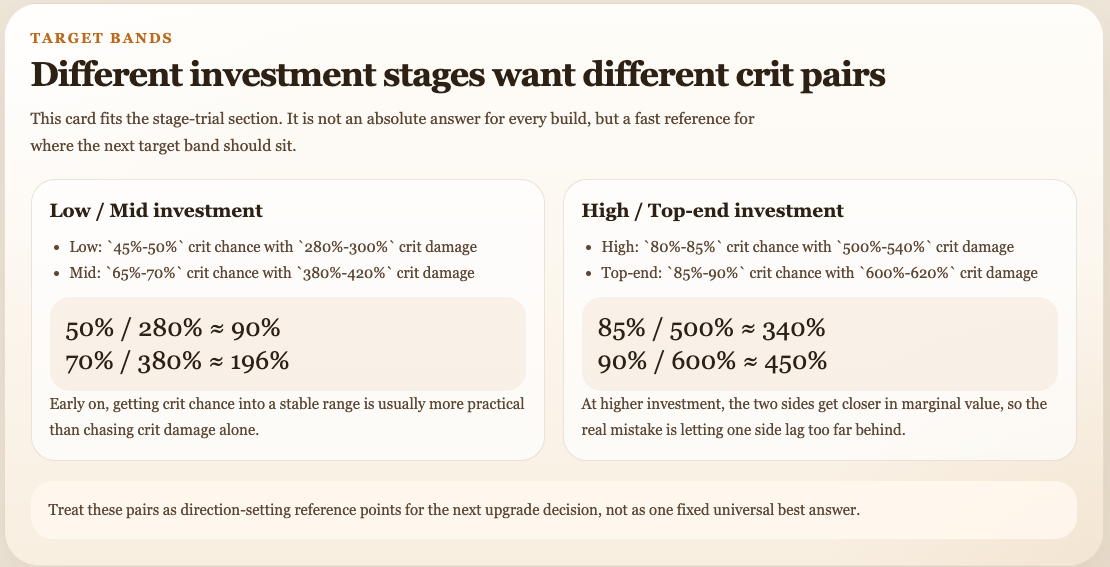
How to choose the next crit investment
Use these as rough stage checks:
- Low investment: first bring crit chance to around
45%-50%, then chase about280%-300%crit damage. - Mid investment: try to reach
65%-70%crit chance while keeping crit damage around380%-420%. - High investment: a common target is
80%-85%crit chance with roughly500%-540%crit damage.
Then decide by shortage:
- If current crit chance is low, add crit chance first.
- If current crit chance is already stable, add crit damage.
- If both sides are already healthy, prioritize the side that is harder to obtain without making the other side fall behind.
One useful marginal check: around 45% / 280%, an extra +30% crit damage is often better than another +5% crit chance. Around 80% / 520%, the marginal gap between the two sides is much smaller.
The point is not that early crit damage is bad or late crit chance is useless. The point is that the two sides gradually move toward balanced investment.
Useful Sources To Recognize
Crit value sources
- weapon or skill base crit value
- flat crit value from gear or mechanics
% crit valuefrom gear, talents, pets, and buffs- conditional combat crit bonuses
Crit damage sources
% crit damageon gear- crit damage from pets, talents, and fate nodes
- temporary crit damage buffs
Example: Blazing Spin
Blazing Spin is a clean example because it feeds both sides:
+435% crit valueduring the buff+14% crit damageper stack
One line raises the crit chance side. The other line raises the crit damage side. Reading only one of them usually leads to the wrong conclusion.
Common Misreads
High crit value does not automatically mean high crit return
It only answers how likely you are to crit, not how much average damage the whole package adds.
A large crit damage line is not always the next best upgrade
If your crit chance is still low, that crit damage is partially wasted.
Looking only at final crit chance hides where the gain comes from
There is a big difference between raising the base and only scaling an old base harder.
Conditional hidden crit often gets missed
Effects like Boneworm's Daughter, High Court Covenant, and Blazing Spin are not well represented by a simple idle tooltip check.
Practical Judgement Order
When you see a new crit line, check this first:
- Is it flat crit value,
% crit value, or crit damage? - Is it always on, or condition-based?
- Are you currently missing the crit chance side or the crit damage side?
- How much real crit chance or average damage does it actually add after full scaling?
The stable rule is still the same:
A good crit setup is not one giant number. It is a connected system where crit chance and crit damage are both high enough to support each other.